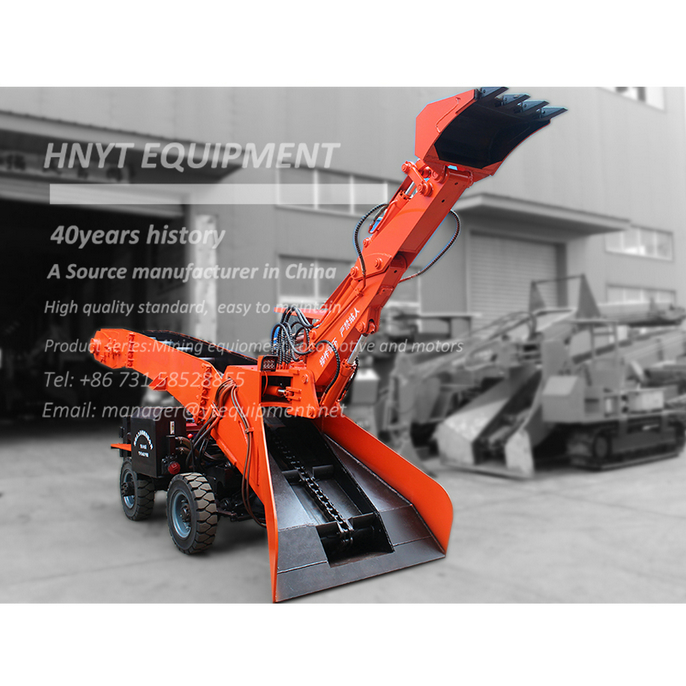
The choice of rock loader between electric and pneumatic rock loaders depends heavily on your specific needs and environment. These two types of machines, while serving the same purpose, have significant differences in their power sources, applications, and long-term costs.
Power Source and Efficiency
Electric rock loaders are powered by an electric motor, requiring a connection to a power grid or a mobile generator set. This power transmission is direct, which results in high efficiency and a more environmentally friendly operation with no exhaust fumes. In contrast, pneumatic rock loaders rely on compressed air. While this makes them ideal for environments without a stable power source, they require a separate air compressor, which can lead to higher overall energy consumption.
Ideal Applications
Electric rock loaders are best suited for mines and tunnels that have a stable power supply and gradients of up to 8 degrees. They are particularly efficient at handling rock sizes between 100mm and 400mm. Pneumatic rock loaders, on the other hand, are commonly used in underground operations with poor ventilation or in areas with strict explosion-proof requirements, where the presence of a live power cable would be a safety hazard.
Maintenance and Costs
Maintenance for electric rock loaders is relatively simple, mainly involving checks of the motor and cables, leading to lower long-term usage costs. Conversely, pneumatic rock loaders require regular maintenance of the air compressor and the associated pipelines, which contributes to higher energy and maintenance costs over time.
Ultimately, the decision comes down to a trade-off between initial rock loader, safety requirements, and long-term operational costs. It's important to carefully consider the specific conditions of your project to make an informed choice between electric and pneumatic rock loaders.